The Last Scale
A night-shift weighmaster has spent two years writing the number she is told to write. Tonight the true one won't let her.
Read by a full cast: your narrator tells the story, every character speaks in their own voice. About 7 minutes.
Narrators are synthetic voices designed for Flinchd or licensed from our speech provider, with invented names. None imitates a real person. Characters are cast automatically, so the person speaking is never the person narrating. A score matched to the genre plays underneath; turn it up or off in the player.
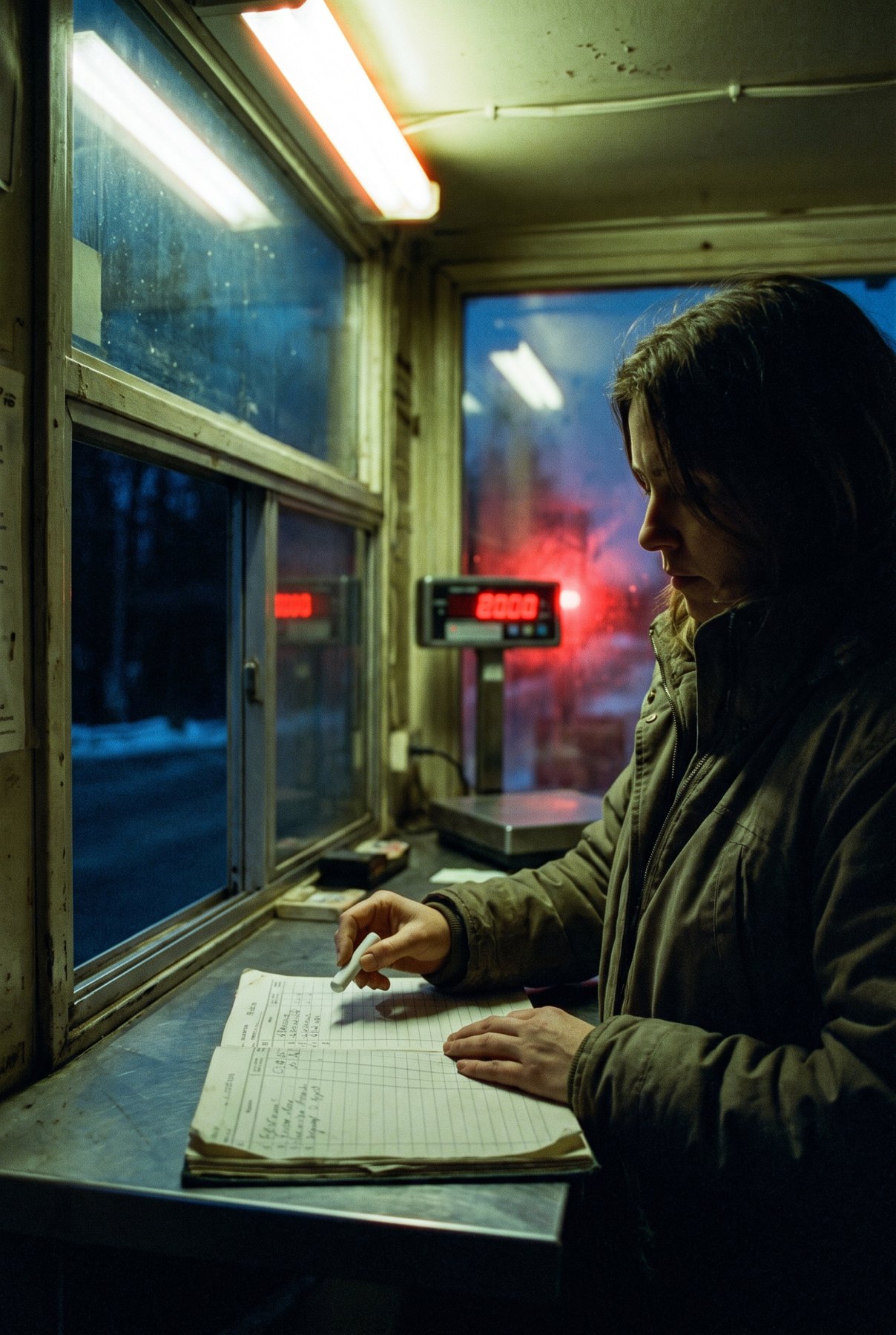
Nadette Vasco was writing a lie in chalk for the four-hundredth time when the booth phone rang, forty minutes early and off every schedule she knew.
She let it ring twice before she picked it up, the way Bowen had taught her, so it never sounded like she'd been waiting by it.
"Spot audits this quarter," said the voice on the line. Draycott never said hello and never said goodbye either, just delivered the sentence he'd called to deliver and left silence where a person might have asked a question. "State's sending inspectors down the corridor. Keep the ledger clean, Nadette."
"It's always clean," she said, and it was true, in the specific and useless way that a forged signature is a perfect signature.
The phone clicked dead. Nadette hung hers up too, and looked at the card taped above the register, laminated soft at the corners from years of hands, Bowen's and now hers.
Underneath Bowen's three rules — never round, never ask, never open — was an older card, the one that had come with the booth, that nobody had bothered to take down: the Public Weighmaster's Oath, the one she had sworn with her hand raised in a county office two years ago.
To keep my scales correctly balanced. To make true weights. To render a correct account. She had read it so many times it had stopped meaning anything, the way any true thing does if you make it share a wall with a lie for long enough.
Most of the forty or fifty trucks she matched a night were exactly what their paperwork said: lumber, dairy, scrap steel, honest cargo weighed honest, no trick to it. The number climbed on the display and the ledger agreed, because there was nothing to disagree about.
But four or five codes a week belonged to what Bowen used to call the company's own. For those the ledger weight had been fixed before Nadette had ever taken the oath, in a hand shakier than the rest of the book, with no relationship at all to whatever the scale actually read.
She matched those too. To the kilogram. She had stopped finding that strange around the third month. That was the part she was least proud of.
Twice in two years the agreement had failed outright, no code, no match, and both times she'd used the phone for the only other thing it was for.
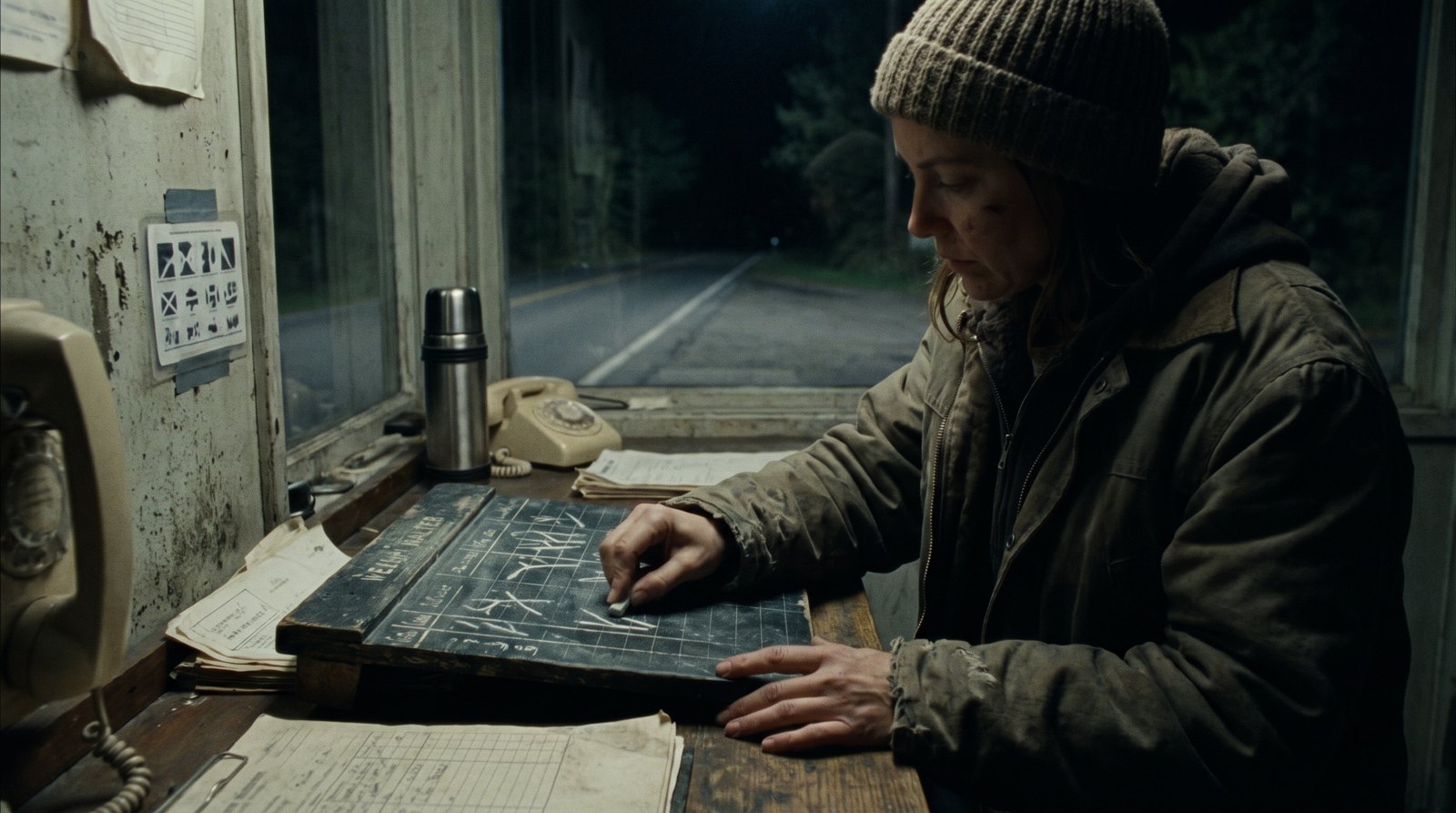
Both times a car with no plates came down from the north within the hour. The driver of whatever truck it was went quiet and cooperative in a way that had nothing to do with paperwork.
She had told herself, driving home at dawn with her hands too tight on the wheel, that this was the company being thorough. She had gotten good at that sentence. She used it the way other people used a seatbelt.
Emil came through every Thursday at two, driving a white refrigerated hauler for a company whose name had worn off the door years before she started. He brought her coffee from the one truck stop on his route that made it properly.
He talked about his daughter, who was learning the trombone badly and with total shamelessness, loud enough, he said, to notify the neighbors of her opinions.
His code was 44912. His ledger weight, in Bowen's shaking hand, was 9,340 kilograms, and it had matched every Thursday for two years.
This Thursday the scale read 9,452.
She read it twice. She read the ledger twice. Emil sat with his window down, the coffee going cold in the cup holder between them, watching her do arithmetic that clearly concerned him more than it concerned her.
"Machine's off," he said. "Probably the rain."
It had not rained in nine days, and they both knew it.
"Nadette," he said. Not a question. Just her name, checking it was still attached to her.
She thought about the hundred and twelve kilograms sitting somewhere behind his cab in the dark, and how that was not a strange weight for cargo. It was also not a strange weight for a person, and once a thought like that gets into a booth this small, it does not leave again.
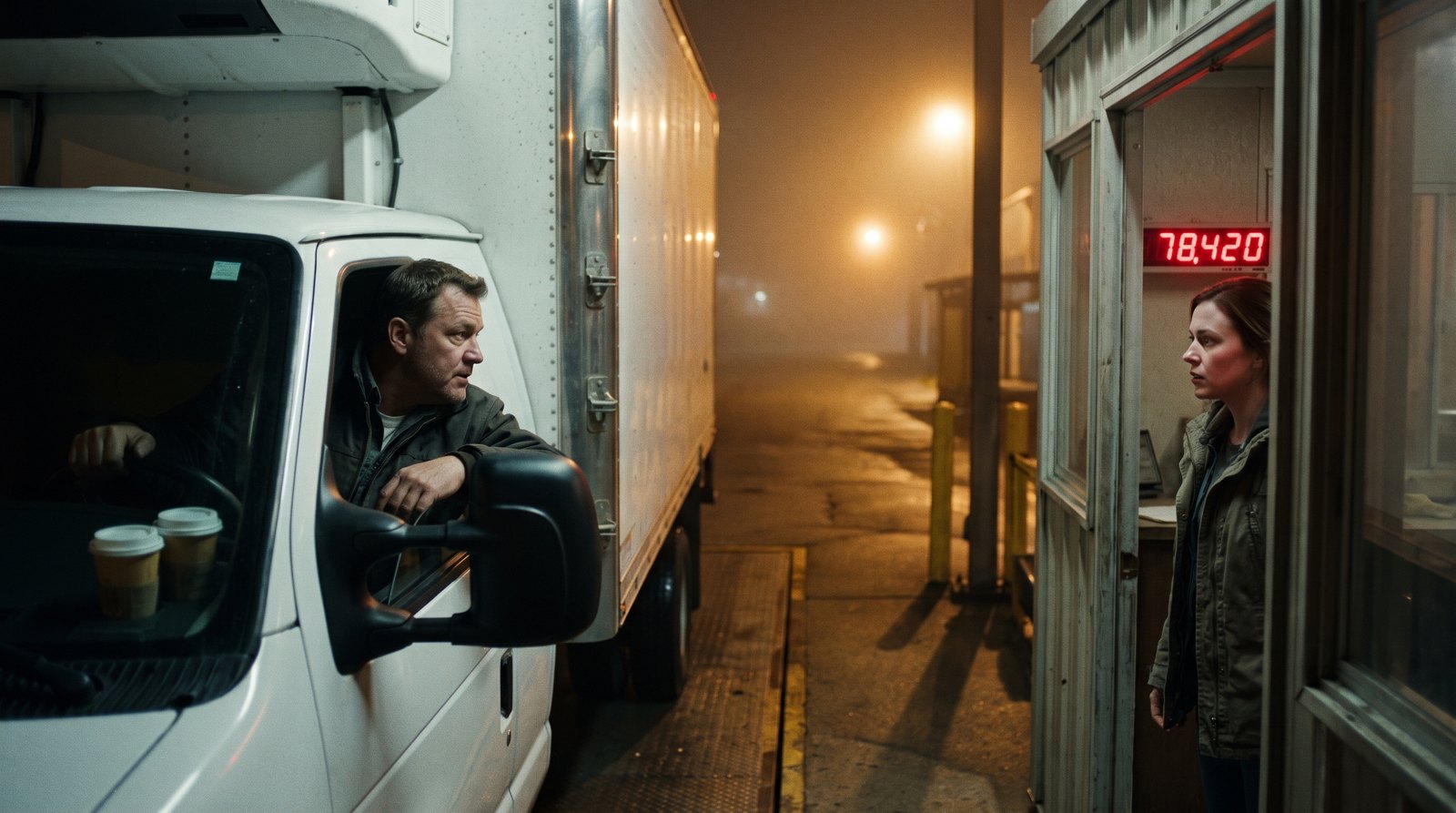
"Sunday's her recital," Emil said, watching her hand hover over the ledger. "I told her I'd be there. I've never missed one."
Nadette had followed the three rules for two years without ever needing to know what came after them, because in two years, in Bowen's hand and hers both, the number had never once been wrong. The card did not say what to do when it was. It had never had to.
She thought about the audit Draycott had just warned her to hide from, and understood, all at once and too late to feel clever about it, that a warning and an opportunity can be the exact same phone call.
She picked up the chalk.
She did not write 9,340. She wrote 9,452, the true number, the one the scale had actually said, in her own hand, on the state's own slip, the kind that got collected and filed and, this quarter, read by inspectors who had never answered to whoever Draycott answered to.
"What are you doing?" Emil said. It was very quiet in the cab of a hauler at two in the morning, and she heard every word of it.
"My job," Nadette said. "For once."
She did not open the trailer. The card said never, and she was not the kind of hero who could stop a truck alone in an empty lot with nothing in her hand but chalk.
But the number on the slip was true now, filed under her signature and her license and an oath she had apparently meant after all. If that number ever got read by the right pair of eyes, it would ask a question that a hundred and twelve unexplained kilograms could not survive being asked.
"Go," she said. "Make the recital."
Emil looked at her for one long second, the way you look at someone who has just done something you can't yet tell is brave or catastrophic. Then he drove into the dark, taillights small, then smaller, then gone around the bend the light didn't reach.
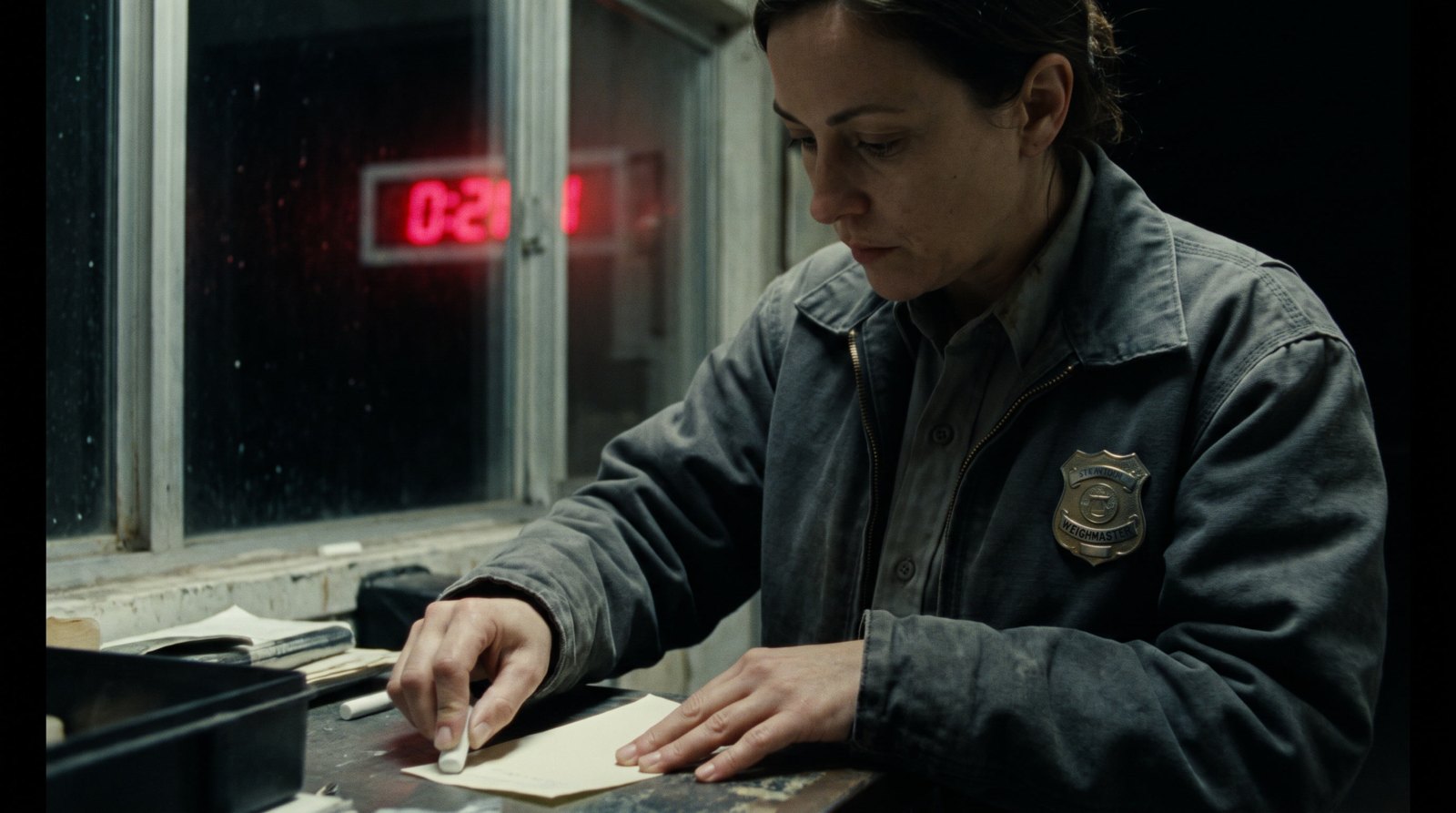
Nadette sat back down. The scale settled itself to zero with a small mechanical sigh, the honest number it returned to when nothing sat on it at all, and for once she found she could look at that one without flinching.
The phone rang at 2:41.
"You wrote it wrong," Draycott said. No hello, same as always, but something under the flatness now, a fraction of a beat that hadn't been there before.
"I wrote it true," Nadette said. "You told me yourself. Inspectors are reading these this quarter."
Silence, longer than Draycott's silences usually ran. Somewhere behind him she heard a door, an engine, the particular hush of a car deciding whether the forty-mile road north was worth taking tonight.
"That's not going to do what you think it's going to do," he said, and hung up before she could find out whether that was a threat or, worse, the truth.
She sat in the buzzing fluorescent quiet for a long time after that, the untouched coffee Emil had left her going cold in its cup, watching the empty road for headlights that did not come from the north and did not come from anywhere at all.
The phone rang once more, near four, and she answered it already braced for Draycott's flat voice.
It wasn't Draycott. It was younger, and out of breath, and it said four words she would turn over for the rest of her life.
"Tell Emil I'm out."
Then the line went dead, and left her holding a receiver with nothing on the other end but a dial tone, steady and impossible to argue with, the most honest sound she'd heard all night.